|
NAVIGATION





















Virtual
Hosting by

TheServerBank
Photos
by John Moss
|
 |
|
 |
|
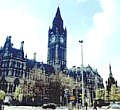
The Town Hall

Manchester's
Busy Bee

Julius Agricola
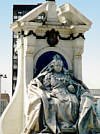
Queen Victoria
Monument in Piccadilly Gardens
|
Manchester
UK
Manchester
is too big a place to include everything about it here. However,
we have tried to make this website as informative, useful, accessible,
extensive and encyclopaedic as we can. We set out to create an
exhuastive guide to the city and the region, including its history
and culture, as well as its business, contacts, entertainments
and accommodation. We are continually adding more as it becomes
available or known to us, and to this end we welcome suggestions
for inclusion.
The City
of Manchester
Manchester is a relatively new city; born of the Industrial
Revolution, it took the lead in the world's textile manufacture
and production in the late 18th century, a position it held until
its decline in the 1960s. Leaders of commerce, science and technology,
like John Dalton and Samuel Arkwright, helped create a vibrant
and thriving economy - most of the nation's wealth was created
in this region during Victorian
times. But it was undoubtedly textiles, and other associated trades,
which dominated and created a young dynamic city, whose very symbol
is the worker bee - an emblem repeated in mosaics all over the
floor of the Town Hall.
Manchester is one of the largest metropolitan conurbations in
the United Kingdom, justly proud of its history
and heritage, its culture,
enterprise and its entrepreneurial
spirit. In more recent times, it has had to reconfigure its
traditional manufacturing base to develop thriving new technologies.
It has rebuilt itself as a leading centre of modernist
architecture since the terrorist
bombing of the city in 1996.
This new sense of vigour and dynamism is evident in the appearance
of an ever increasing number of city centre
hotels, luxury apartments
and self-catering accommodation.
It is a tribute to its people and planners of Manchester that
the city arose again out of the ashes of this atrocity, phoenix-like,
to become a thoroughly modern city - a leading light of the 21st
century.
|
An
Historic Town
The original Manchester was an old
town which has been inhabited since Roman times, when General
Julius Agricola built a fort
just north of the site of present day city,
though it was not until the 18th century that this hitherto remote
and inconspicuous little medieval township sprang into the forefront
of world attention, and not until the mid-19th century that it
became a city. Actually, it was the neighbouring City
of Salford that dominated the region, and the Salford
Hundred covered all lands between the River Ribble to the
north and the Mersey to the south, and to this day the sovereign
still bears the title of Lord of the Manor of Salford. Not until
the 19th century, after many protests and petitions to parliament,
notably by the Chartists,
did Manchester gain the status of a city.
Manchester
& the Industrial Revolution
During the Industrial Revolution the powerhouse that was Manchester
became the hub of a wide network of many small Lancashire townships
- "little Manchesters" as they were sometimes known
- towns that serviced the city's massive cotton industry. Places
like Blackburn, Burnley, Bolton,
Wigan, Salford,
Oldham and Rochdale,
(to name but a few) sent their woven and spun produce to the Exchange
in Manchester and from thence to the world via the newly created
Manchester Ship Canal,
and received raw materials which were distributed out from the
city and its well established system of canals
and railways.Steam power drove the Victorian city, with water
from the many local rivers like the Irwell, Medlock, Irk and Tame,
and coal from Worsley via the Duke
of Egerton's Bridgewater
Canal to Castlefield,
or other coal
pits around Wigan.
The City of Manchester and innumerable small
satellite towns and villages surrounding it saw the rapid
growth of factories manufacturing merchandise for cotton weaving
and spinning, dyeing, fulling and all apects of the textile industry.
Manchester was nicknamed "Cottonopolis"
where 'King Cotton' ruled. Even today, Manchester is marked by
its many fine surviving warehouses
(now mostly hotels and executive apartments) and mills
(now frequently relegated to small industrial units). It held
onto its reputation as the prime source of world textiles until
its decline in the 1950s, when cheaper foreign imports sounded
the death knell for the region's pre-eminence.
Greater
Manchester
In the 1970s, Greater Manchester
was born - a still controversial grouping of 8 boroughs and 2
cities, which were subsumed into one large administrative connurbation,
the Metropolian County of Greater Manchester. Two
of these, Tameside and Trafford, were newly created (again, quite
controversially) for the purpose, while other former County Boroughs
like Bury, Oldham and Rochdale (in Lancashire) and Stockport (in
Cheshire) lost their administrative independence to a large degree
to the new Metropolitan County.
This "county" still produces more than half of Britain's
manufactured goods and consumables, though manufacturing continues
its steady decline.
Greater Manchester is a big place. While 2.6 million people live
within its actual boundaries, over 7 million others live in the
wider region, making it second only to London in Great Britain.
For 11 million people living within 50 miles of the City of Manchester,
it is the place where they come to work, or to shop or to visit
the many attractions and entertainments
which only a large dynamic city such as this could hope to offer.
Continues
Next Page >
|
|
Site
Map | Accommodation
| Arts & Culture | Business
& Insurance | Day Trips | Hotels
| Food & Drink | Entertainment
History & Heritage | Education
& Training | Information & Emergencies
| Local Celebrities | Maps
& Location Plans
Meeting Places | Shopping
| Sports & Leisure | The
Ten Boroughs | Transport | Worship
& Religion | Links | Privacy
Manchester Airport Parking
| Code of Ethics | Facts
& Figures | Virtual
Tours | Papillon
Graphics | Districts of Manchester
Manchester Hotels | Cheshire
| Lancashire | Book
a Hotel | Manchester
Weather | About | Facts
& Figures | Awards
Manchester Airport | Search
Website | Contact Papillon Graphics
| Advertise | A-Z Index
Back
to Top
|


